Damascus Steel – A Beginner’s Guide

Our Kernice Steel subscriber students often ask me about
Damascus Steel. This fascinating but unusual tool has taken the minds of many
so I will do my utmost to explain what it is and how it is done.
The term "Damascus" returns to western
traditions and refers to the previous style of employment originally introduced
in India about 300 BC. Great art at the time, and maybe a region that makes us
famous.
About that time, the Arab culture
promoted Wootz steel in the Syrian city of Damascus when things led to a
desperate field. Damascus was sent by Wootz steel from Damascus to
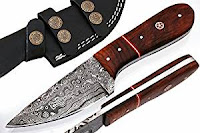
the production and use of Handmade Damascus Steel Hunting Knife hybrid known as difficult. Obviously, the
minds of these technological advances are understood that the combination of
different metals will make weapons more powerful than steel.
Therefore, Damascus iron is not clean. In fact, this
unique is its favorite and its mystery. This story is considered by many belts
and mottling combined with portable festers to create decorative cakes and any
height and / or length that you can not scatter. Identifying themes in South
African origin of South Africa may be unknown today, as no records exist. But
modern Damascus builds bells following the practice of combining clean metals,
varying according to your will and need. While metalworkers can choose and
combine building materials for building buildings, iron will accept its strong
and durable strength.
Historically, Damascus's
reputation has embraced a complex reputation, as the first quotes disappeared
about 1700 A.D., a point of view of the decline in portable swords that will
end in production fifty years later. The traditional tradition and importance
of Damascus steel, but, has never been forgotten, so the growing industry
exists today.
Steel
Composition
Scientific steel and metalworking
are very involved, but it confirms the complexity and complexity of Damascus's
tactics and processes and are respected and respected. Metallurgy and chemistry
work as a basis for the composition and many required systems for steel
production and use.
It is interesting that Demasech
steel was regarded as "a big plastic," not because of the idea that
it was not a real metal-though it was never clean-but because of the stability
caused by prediction. Despite the fact that various types of modern metal have
raised active Damascus, chemicals in the first production sector combine the
last part of the normal and powerful period.
Since 1973, Damascus's modern
metal shingles have been made of a variety of metallic metals assembled
together to make banks. These tablets also contain metallic instruments to
provide the required strength at the molecular level. As a result, they are
presented and classified according to the requirements indicated by the
different uses of the page and the blade owner preferences. This indicates that
Damascans in Damascus are not based on the fashion of the organization but on
the basis of each individual's own.
The process is simple: metallic
instruments make buckets mixed with "sandwich" within some types of
metal. The resulting product can include up to hundreds of locations, and you
will definitely have solid stability and various designs. This tested process
guarantees both the integrity and diversity of Iron Damascus at all times.
However, the basic composition of iron Damascus has two
types of building: the sensitivity and self-control. The previous allows
depression to detect power expansion that will not reduce or eliminate the failure
of the blade. This name is misleading, since usually it is a weakness. However,
in this case, this term refers to the level of flexibility required to prevent
dispersion or division, as well as to promote the edge of sharpness.
This building structure
guarantees that the leaf of Damascus easily eases and remains stable. Convex
grind gives a sharp edge to the throat reduction so that the soft material
grows on the sides during the abnormalities of the body and thereby reduces the
"adhesion" that often occurs with strings with bad edges. Therefore,
structural writing, it is necessary to judge.
At a deeper level, the carbon
nanotubes phone form allows for poor performance and continuous stability
during the process of celebration. Carbon concentrous carbon guarantees the
quality of iron quality assurance that guarantees high performance. This
explains why carbon is essential for the development of steel steel blades.
During the construction process,
small metallic instruments are gradually made into the design. This causes the
correction of iron carbides into bonds that create different patterns. These
industries remind the grain of Wootz steel from ancient India and shows ancient
art and production art. Metalworkers today are able to repeat much of the same
known Damech steel as centuries ago.
Heating and Finishing
Below are general warming lists
and completing Damascus's steel processing processes. In addition, what is said
varies in accordance with the requirements and requirements, as well as the type
of metal that is combined. Basic procedures are always the same.
Massive steel heat involves
pre-heat temperatures between 1,500F and 2,000F, depending on the belt, and the
two-dimensional cementite and austerntite.
·
Firefighting
begins.
·
Place the
block in a fiery furnace. Heat with its cycle until its first heat.
·
After heat,
insert iron with iron in ten minutes.
·
Close iron
in the oil. Transfer to selected nitrogen per hour.
·
Metal Make
time for 350F hours to heat. This should be done twice.
The following steps show the following complete
treatment.
·
Apply
to end grit at last.
·
Apart
from the initial smell, the etch at 50/50 is a purified solution of ferric
chloride and distilled water.Leave a solution for solving ten minutes.
·
Remove
and remove the water from the active water.
·
Repeat
the cycle for five minutes and reach the desired result.
·
Avoid
tri-sodium phosphate volume to minimize the end.

Comments
Post a Comment